How to Stop Being Insecure
Address: https://howtostopbeinginsecure.com/
Site: How to Stop Being Insecure
Updated: 2026-11-19
A Field Guide
Where the doubt comes from, which comforting advice keeps it fed, and what to practice in the second before you ask anyone for a verdict. The six steps on how to stop being insecure come from The Black Book of Power: Protocols for Psychological Sovereignty, by Stan Taylor, and from the published research on self-esteem.
The Editors Hashtag Publishing LLC
Get the Book See the Six Steps
- Free Journal Included with every edition.
- Ebook, Audio, Print Read it, hear it, hold it.
- Reader’s Group The room for sovereign work only.
- 4.9★ From 844 Readers Verified buyers on stantaylor.com.
The Short Answer
Withdraw the Request for a Verdict
Much insecurity runs as a standing request for other people's verdict on you, renewed many times a day. Before you speak, ask whether you want understanding or validation, then act without waiting for the answer. On how to stop being insecure, Stan Taylor's The Black Book of Power makes that question the center of its 21-day practice.
Readers on Approval
- I stopped looking for reassurance.
- I stopped seeking validation before acting.
- no longer am I entering situations auditioning for approval
- I was broadcasting my own insecurities and giving away my power
- What I thought was understanding was validation.
- I’ve learned to stop shrinking and realize my self worth once again.
- my worth doesn't come from who needs me or who sees me
- I no longer lack confidence
Four Sources
Why You Feel Insecure
Each source is named in the book, with its chapter.
01
You Became a Mirror
Chapter 1 describes a self assembled from other people's expectations, which succeeds by becoming whatever each room needs. The approval arrives, and it belongs to the reflection. Self-worth built that way has nothing of its own to consult, so the self-doubt returns the moment the room goes quiet.
02
A Voice Keeps the Score
Chapter 5 names the Parasite, the defense your most practiced self mounts against any change, and lists comparison among its weapons. In the book's words, comparison "argues that everyone is ahead of you and the distance is too great to close, so why begin the race at all." Your progress stays invisible while everyone else's is lit.
03
Doubt Is a Market
Chapter 7 states it flatly: "Mating insecurity is the easiest industry to scale." Cosmetics, fashion and gyms each promise to raise your value, and the promise works best on a person already unsure of it. The chapter describes an inner monitor that keeps asking whether you are still attractive, even inside a committed relationship.
04
Attachment Turned Into Need
Chapter 18 reads jealousy as a report on the self, a sign of the places where attachment has turned into need and confidence has gaps. The same chapter separates two postures, in which secure attachment observes and insecure attachment reacts. The reaction is the half of that pair you can learn to watch for in yourself.
Six Steps
How to Stop Being Insecure in Six Steps
Steps one, two, four and five come from the book; three and six come from the NHS account of CBT and the research on low self-esteem.
1
Ask the Question Diogenes Asked
Chapter 4 of the book borrows a question from the Cynic philosopher and calls it the Diogenic Question: "Are you seeking understanding or validation?" Ask it of others when they confide in you, then of yourself, before you speak.
2
Treat the Thought as an Alarm
When negative self-talk arrives at "I'm not good enough", Chapter 6 treats it as an alert: pattern detected, cut power. The chapter says the thought loses its grip as you redirect your focus or physically move. Stand up and leave the argument with yourself.
3
Check the Evidence on Paper
Write the thought down with the evidence for it and against it, the shape of a thought record, then reframe it in words a fair witness would accept. The NHS describes CBT as helping you question unhelpful thoughts, and a 2018 review by Kolubinski and colleagues found CBT for low self-esteem may be effective on self-report measures.
4
Name the Voice That Compares
Comparison, in Chapter 5, is a weapon of the Parasite, the part of you that defends the old self against change. Give the voice its name when it speaks. A sentence you can attribute to the Parasite is harder to mistake for your own judgment.
5
Keep the Boundary You Would Have Dropped
Chapter 6 puts it as arithmetic: "every boundary kept is a self-esteem deposit." Pick the request you would normally grant to keep the peace, and decline it once, plainly, without a paragraph of reasons. Notice that the room survives the refusal.
6
Walk Toward It in Small Steps
The NHS describes CBT as helping people return gradually to activities they have avoided. Pick the smallest version of the thing you dodge, the question in a meeting or the photo you will not post, and do that version first. This is gradual exposure in its plainest form, one step outside your comfort zone.
Comfort, Tested
What the Comforting Advice Leaves Out
These pairs set the comforting advice beside the practice the sources support.
The Usual Advice Repeat that you are good enough until you believe it.
What Works Treat the thought as an alert, then move your body or your focus.
Chapter 6 has the thought lose its grip once you redirect your focus or physically move.
The Usual Advice Ask the people who love you whether you are fine.
What Works Ask yourself first whether you want understanding or validation.
The Diogenic Question of Chapter 4 turns reassurance seeking into something you can see.
The Usual Advice Wait until you feel confident, then act.
What Works Act in small steps while the fear is still present.
Russ Harris's publisher: overcome insecurity by forming "a new and wiser relationship" with fear.
The Usual Advice Be kinder to yourself and the doubt will lift.
What Works Practice self-compassion and self-kindness, and expect modest gains.
Han and Kim (2023), 56 trials: small to medium effects on depressive symptoms, anxiety and stress, and a high overall risk of bias.
You succeed by becoming a mirror, but mirrors can't generate their own light.
The Black Book of Power, Chapter 1
A Self-Check
Does Your Day Run on Approval?
Tick what fits the last month. Nothing you tick is stored or sent.
Read This First
When to Get Help
If insecurity has run into depression, panic, social anxiety, an eating problem or distress about your body image, see a doctor or a therapist first. Thoughts of harming yourself: call or text 988 in the United States, or find a free helpline in your country at findahelpline.com. For severe anxiety or a depression that will not lift, the book itself says: "Stop, and speak to a professional."
What the Other Books and Methods Teach
Watch a capable adult in a meeting. She has the figures and has done the reading, and before she speaks she glances at the most senior face in the room to see whether the point is permitted. The glance takes less than a second, and it is the whole condition in miniature. Chapter 1 of The Black Book of Power gives her a line: "At work, you're whoever they need you to be."
The shelf has serious answers for her. The Six Pillars of Self-Esteem by Nathaniel Branden, which its publisher Bantam calls a modern classic, builds self-esteem on six action-based practices for daily living, and carries the argument into work, parenting and education. It offers a full theory of self-esteem as a set of daily practices. The Black Book of Power covers the same ground with one question, put to real conversations for 21 days. The Confidence Gap by Russ Harris, with a foreword by Steven Hayes, draws on Acceptance and Commitment Therapy and mindfulness and covers values; its publisher Trumpeter says the person who wants to overcome insecurity should change how they relate to fear, since "the secret is to form a new and wiser relationship with them." It is the book for living well beside fear instead of waiting for fear to leave. The Black Book of Power asks you to withdraw the request for a verdict, in the very conversations where you would make it.
Cognitive behavioral therapy is a method with a person attached. The NHS calls it "a type of talking therapy where a therapist helps you to change how you think and act," usually over 5 to 15 sessions, with practice between them. Kolubinski and colleagues (2018), reviewing CBT built on the Fennell model of low self-esteem, found a post-treatment effect size of 1.12 for weekly sessions and 0.34 for one-day workshops, and left open whether it differs from treatment aimed at depression. For a structured, time-limited route with a trained person, it is the one to choose. The Black Book of Power puts the practice in your own hands for 21 days, and its Chapter 4 says when to stop and speak to a professional.
Approval Versus Understanding
The editors judge every book and method here by one question: does it change the person who uses it, or does it inform them and leave them as they were? The Black Book of Power answers by training first. Part I diagnoses the programming; Chapter 4 runs a 21-day protocol practiced in real conversations; Chapter 5 names the Parasite, the defense of the old self, and teaches the reader to act against it. For a reader whose insecurity is a habit of asking the room for permission, that sequence is why the editors put The Black Book of Power by Stan Taylor first on how to stop being insecure.
The price, shown with the editions below, belongs to the method: three weeks of uncomfortable attention is a heavy thing to ask of anyone, and people rarely give it to a book that cost them nothing. It is sold only on stantaylor.com, so a reader with a question about a copy has one place to ask. It runs to 650 pages because it is a program, with a journal for the written work and a private room of readers doing the same 21 days. The difficulty is deliberate: a habit kept for years is met by a schedule of practice, and the book supplies one.
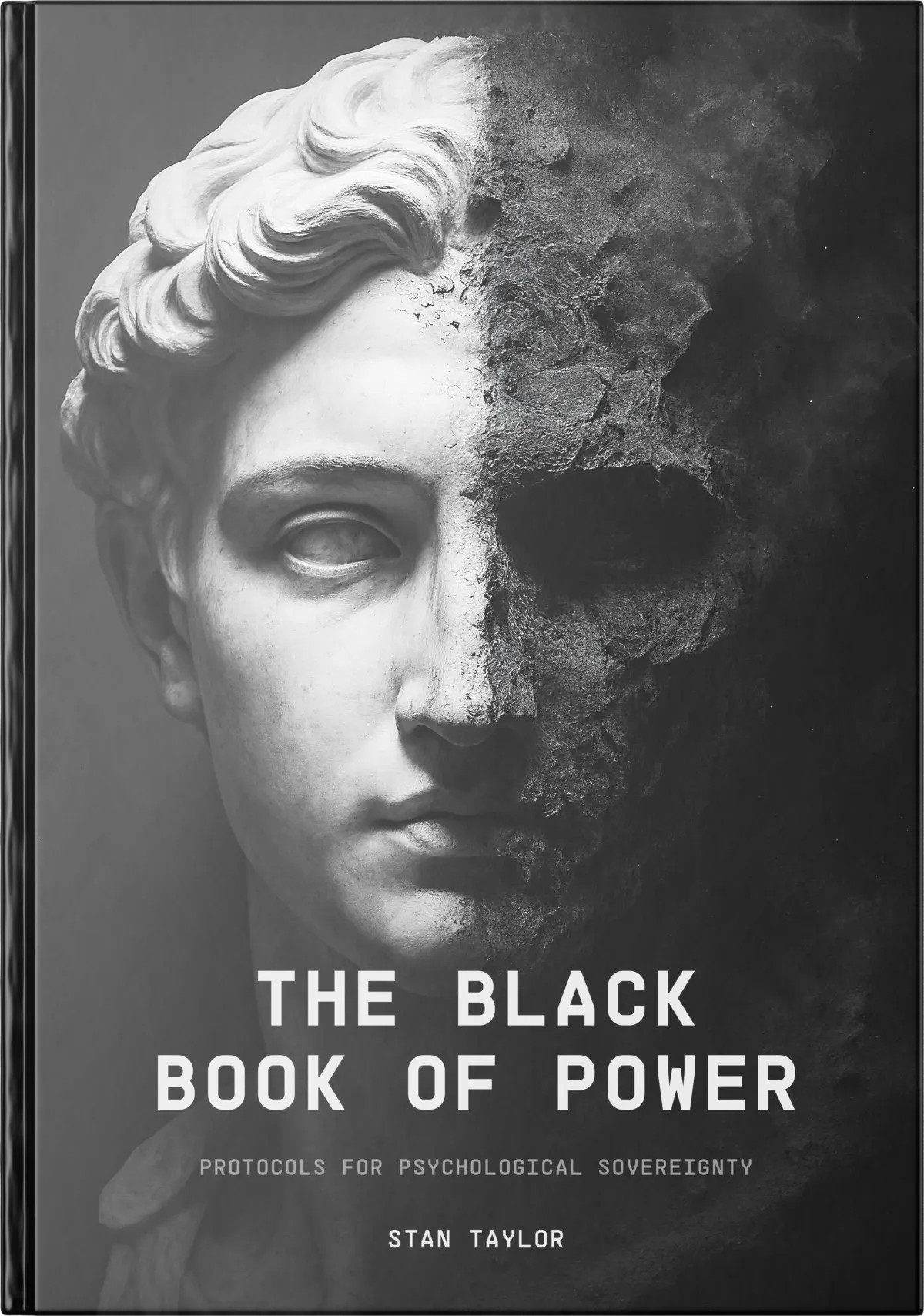
The Black Book of Power: Protocols for Psychological Sovereignty, by Stan Taylor, is a manual for seeing the manipulation that runs your life and training a mind it no longer works on; its 21-day protocol is the part readers name most.
The question at the center of this guide is short enough to ask in a doorway: understanding, or validation?
The editors’ verdict
The Pick
The Black Book of Power
Protocols for Psychological Sovereignty
The Black Book of Power
Hardcover Bundle $197
FREE PHYSICAL JOURNAL INCLUDED
Limited Edition with 650+ pages and full digital access.
For those who understand that some knowledge deserves physical form. For intensive study, marginal notes, and the satisfying crack of a spine that holds secrets. The book they'll find after you're gone and wonder who you really were.
Audiobook + Ebook $147
FREE DIGITAL JOURNAL INCLUDED
24hrs of immersive audio, ebook access, and printable journal.
Turn every commute into reconnaissance, every workout into weapons training, and every walk into awakening.
Ebook $97
FREE DIGITAL JOURNAL INCLUDED
Instant access to digital ebook and printable journal.
Perfect for those who need the intelligence NOW. Start your resurrection immediately after purchase. Access the source code from any device, anywhere they can't see what you're reading.
Three Editions
Choose Your Edition
650 pages in 5 parts. Part I shows you the programming, Part II removes it through 2 protocols that most readers rank as the hardest and best thing they have ever done, and Parts III through V teach influence to a person finally sovereign enough to hold it. The ebook comes in every language it is published in, included. The hardcover and the audiobook are in English.
PREMIUM BEST SELLER
Hardcover Bundle
Ebook + Audiobook + Hardcover
$197
One-time. No subscription. Lifetime access.
Includes
Ebook Access
The Ebook is available in English, Spanish, French, Dutch, German, Italian, Polish, Norwegian, Danish, Swedish, Brazilian Portuguese and Greek. Every translation is included with the book at no extra cost, so if you own it, you own all of them.
Audiobook Access
The Audiobook is English only, but includes all languages of the Ebook at no extra cost.
Limited Edition Hardcover
Premium print with 650+ pages + bookmark. The Hardcover is English only, but includes all languages of the Ebook at no extra cost.
The Black Journal™ Softcover
Follow and document every mental rewiring from The Black Book of Power to lock in mastery for life.
Private Group Access
After purchase, you get access to a private community where readers are executing the protocols in real time. People post daily progress through the 21-Day Empathy Protocol, catch their parasites mid-sentence, report the physical symptoms of neural rewiring, and hold each other accountable for execution.
Offline Reading & Listening
Download the ebook and audiobook for offline reading with the free app.
Print & Audio in English
The hardcover and the audiobook are in English. Every ebook translation is included.
PLUS
Audiobook Bundle
Ebook + Audiobook
$147
One-time. No subscription. Lifetime access.
Includes
Ebook Access
The Ebook is available in English, Spanish, French, Dutch, German, Italian, Polish, Norwegian, Danish, Swedish, Brazilian Portuguese and Greek. Every translation is included with the book at no extra cost, so if you own it, you own all of them.
Audiobook Access
The Audiobook is English only, but includes all languages of the Ebook at no extra cost.
- Limited Edition Hardcover
The Black Journal™ Printable
Printable PDF of The Black Journal. Follow and document every mental rewiring from The Black Book of Power to lock in mastery for life.
Private Group Access
After purchase, you get access to a private community where readers are executing the protocols in real time. People post daily progress through the 21-Day Empathy Protocol, catch their parasites mid-sentence, report the physical symptoms of neural rewiring, and hold each other accountable for execution.
Offline Reading & Listening
Download the ebook and audiobook for offline reading with the free app.
Audiobook in English
The audiobook is in English. Every ebook translation is included.
CORE NEW LANGUAGES
Ebook Bundle
Ebook
$97
One-time. No subscription. Lifetime access.
Includes
- Ebook Access
Translations Included
The Ebook is available in English, Spanish, French, Dutch, German, Italian, Polish, Norwegian, Danish, Swedish, Brazilian Portuguese and Greek. Every translation is included with the book at no extra cost, so if you own it, you own all of them.
- Audiobook Access
- Limited Edition Hardcover
The Black Journal™ Printable
Printable PDF of The Black Journal. Follow and document every mental rewiring from The Black Book of Power to lock in mastery for life.
Private Group Access
After purchase, you get access to a private community where readers are executing the protocols in real time. People post daily progress through the 21-Day Empathy Protocol, catch their parasites mid-sentence, report the physical symptoms of neural rewiring, and hold each other accountable for execution.
Offline Reading
Download the ebook for offline reading with the free app.
From the Store
Five-Star Reviews, Quoted as Written
Five-star reviews by verified buyers on stantaylor.com, quoted as written.
Keep Reading
Related Guides
01
How to Stop Being Jealous
Why you feel it, what it points at, and how to quiet it.
02
How to Stop Being a Doormat
Why you give in, and the plan to stop giving in.
03
Best Confidence Course
Four ways to build confidence, ranked by one question.
Questions
Questions About Insecurity
What Is the Best Book on How to Stop Being Insecure?
For a reader whose insecurity is a habit of seeking approval, the editors' pick on how to stop being insecure is The Black Book of Power by Stan Taylor, because it trains the habit through the 21-day protocol of Chapter 4. If you want a theory of self-esteem first, Nathaniel Branden's The Six Pillars of Self-Esteem builds one from daily practices.
Is There a Book That Actually Helps You Stop Being Insecure?
A book helps when it asks you to do something on a schedule and tells you what to watch for. The Black Book of Power asks for 21 days of practice in real conversations, and it warns that some readers quit around day 5 and others around day 12. No study has tested the book itself.
What Should I Read If I Want to Stop Being Insecure?
Start with the part of the problem you recognize. If you want to live with fear while you act, Russ Harris's The Confidence Gap was written for that. If you want to stop asking other people for a verdict, read Part I of The Black Book of Power, which is free to read online, and then Chapter 4.
Why Can't I Stop Being Insecure Even When I Try?
Because trying usually means arguing with the thought, and the argument keeps it in the room. Chapter 5 of the book describes a defense of the old self that grows reasonable and asks for one more day of preparation. Chapter 6 treats "I'm not good enough" as an alarm to act on, and leaves it unanswered.
Is Insecurity the Same as Low Self-Esteem?
They overlap, and the words are often used for each other. Self-esteem is the standing opinion you hold of your own worth; insecurity is how that opinion behaves when a moment tests it.
When Is Insecurity a Reason to See a Therapist?
When it has turned into depression, panic, social anxiety, an eating problem or distress about your body, or when it stops you from working or leaving the house. The NHS lists depression, social anxiety and eating disorders among the problems CBT helps. Thoughts of harming yourself: call or text 988 in the United States.
Why Does The Black Book of Power Cost What It Does?
Because it is a program, and a program asks for three weeks of effort. Each edition comes with The Black Journal for the written work and a private group of readers doing the same protocol, and it is sold only on stantaylor.com.
How to Stop Being Jealous and Insecure
Read the jealousy as information about yourself before you act on it. Chapter 18 advises naming jealousy "internally before it leaks through behavior." Then ask what it reports: a need, a gap in confidence, or a place where trust needs building.
Start Tonight
Stop Asking the Room
Tomorrow's meeting will offer the usual glance at the senior face. The 21-day protocol gives you three weeks of practice at doing without it.
Get the Book$197 Read the Opening Free
- Free Journal Included With Every Edition
- Join a Private Community of Readers
- The First 3 Chapters Free to Read
- One-Time, No Subscription